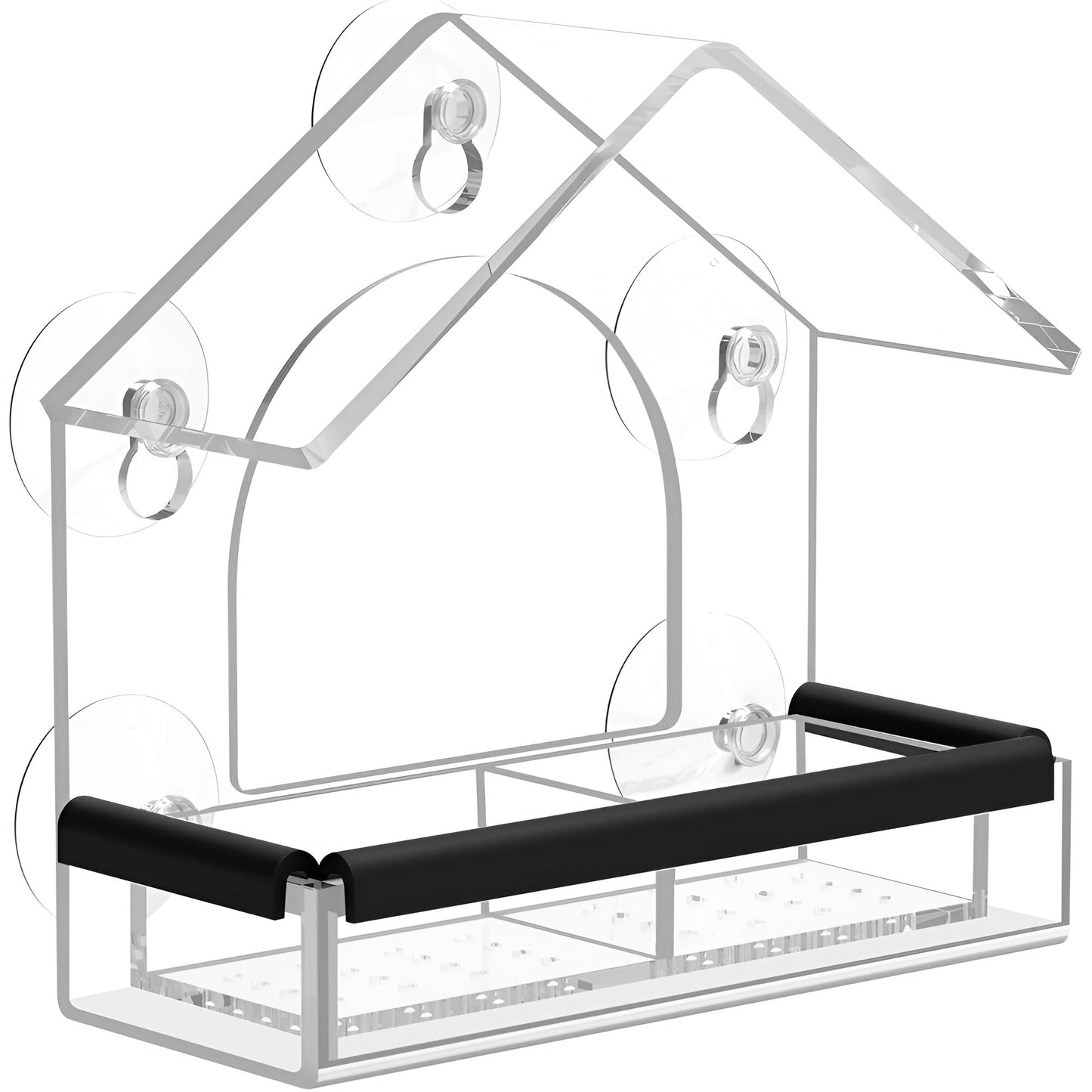
Transparent Window Bird Feeder with Suction Cups, Removable Tray, and Non-Slip Perch
Transparent Window Bird Feeder with Suction Cups, Removable Tray, and Non-Slip Perch


Couldn't load pickup availability
Winter Breakfast: The kids are asking again when the birds will come back to the garden
You live in an apartment without a garden, or with a balcony where birds never venture. The children watch titmice in wildlife documentaries on television, but never see a real bird up close. This feeder attaches directly to the living room window with suction cups, attracting neighborhood passerines just inches from your face, and turning your window into a live show for the whole family.
What distinguishes this format from classic garden feeders
- Strong suction cup attachment to glass ensures a solid hold even with several birds simultaneously, without drilling into the wall or complicated assembly — the feeder installs and moves in minutes depending on the chosen window.
- Fully transparent acrylic creates no barrier between your gaze and the bird, so observation happens just inches away instead of the usual several meters for a garden feeder where binoculars are needed to distinguish species.
- Sloping gable roof protects food from vertical rain and snow, while keeping the perch area ventilated to prevent mold on seeds — the grain stays dry and consumable for several days after filling.
- Removable compartmentalized sliding tray extracts without detaching the feeder from the window, simplifying weekly cleaning and allowing multiple types of food to be offered simultaneously (mixed seeds, fatty pellets, fat ball crumbs) to attract different species.
- Non-slip horizontal perch with rubberized coating provides a comfortable resting place for birds' feet, so they stay longer to eat instead of flying off prematurely at the slightest imbalance.
- Apartment window friendly size that doesn't protrude excessively indoors or outdoors, compatible with modern double-glazed windows as well as older single-glazed windows, provided the glass is smooth and clean.
Who it's for
For urban apartment families without a garden who want to offer children direct contact with local wildlife, seniors and people with reduced mobility who spend a lot of time at home and enjoy a live spectacle at their window, wildlife photography enthusiasts who want to capture close-up images without expensive telephoto lenses, indoor cat owners who are fascinated by watching birds through the glass (with no risk to the birds protected by the glass), schools and daycare centers that want to integrate nature observation into learning, and gifts for grandparents who enjoy amateur ornithology.
And long-term daily use
For installation, first perfectly clean the inside and outside of the chosen window with a standard glass cleaner, meticulously wiping away any greasy residue — suction cups hold poorly on dirty glass or glass covered with an invisible film of atmospheric dust. Lightly moisten each suction cup with a finger dipped in clean water before placement, which improves initial adhesion, then press the feeder firmly against the glass, applying even pressure to each suction cup for a few seconds. Ideally, choose a window facing east or southeast, sheltered from strong wind and direct driving rain if possible. Avoid windows with high human traffic directly behind them (main entrance, circulation stairwell), as birds flee sudden close movements. To attract the first birds, be patient — it generally takes 5 to 14 days for neighborhood titmice and sparrows to discover a new food source. To speed up the process, choose very attractive seeds initially: hulled sunflower seeds (preferred by titmice and goldfinches), Cardère mix for garden passerines, or suet pellets for robins. Avoid bread (bad for bird digestion), salted seeds, and all processed foods. For feeding frequency, it's ideal to feed regularly rather than a large quantity at once — birds get used to coming every day and the feeder becomes a fixed point in their territory. During cold periods (November to March), maintain daily feeding to help non-migratory species get through the winter. During warm periods (April to October), reduce the quantity or stop feeding to avoid creating an artificial dependence that disadvantages fledglings who need to learn to feed naturally. For suction cups that loosen over weeks (a normal phenomenon linked to micro-dust infiltration), detach the feeder every 1 to 2 months, clean suction cups and glass with warm soapy water, dry, and reattach according to the initial procedure. For tray cleaning, remove it completely by sliding it out every 1 to 2 weeks in winter, or more often in wet weather if visible mold appears. Wash with hot soapy water, scrub with a soft brush to remove stuck residue in corners, rinse thoroughly and dry completely before refilling. Avoid bleach and chemical disinfectants that could leave toxic residues for birds. For bird safety, avoid locations where cats could hide directly underneath (dense shrubs, low hedges) — birds need clear visibility around the feeder to spot predators.
For those who want children to learn to recognize a titmouse by sight, not just in a book.
Shipping Information
Shipping Information
At Novana, you always enjoy free shipping. Not completely satisfied with your purchase? You can return your product within 30 days. Feel free to contact us for help with your return.
30-Day Hassle-Free Return
30-Day Hassle-Free Return
Not satisfied? No worries! At Novana, you have 30 days to return your order hassle-free. We make sure your shopping experience is smooth and trouble-free, so you can always shop with us with confidence.